

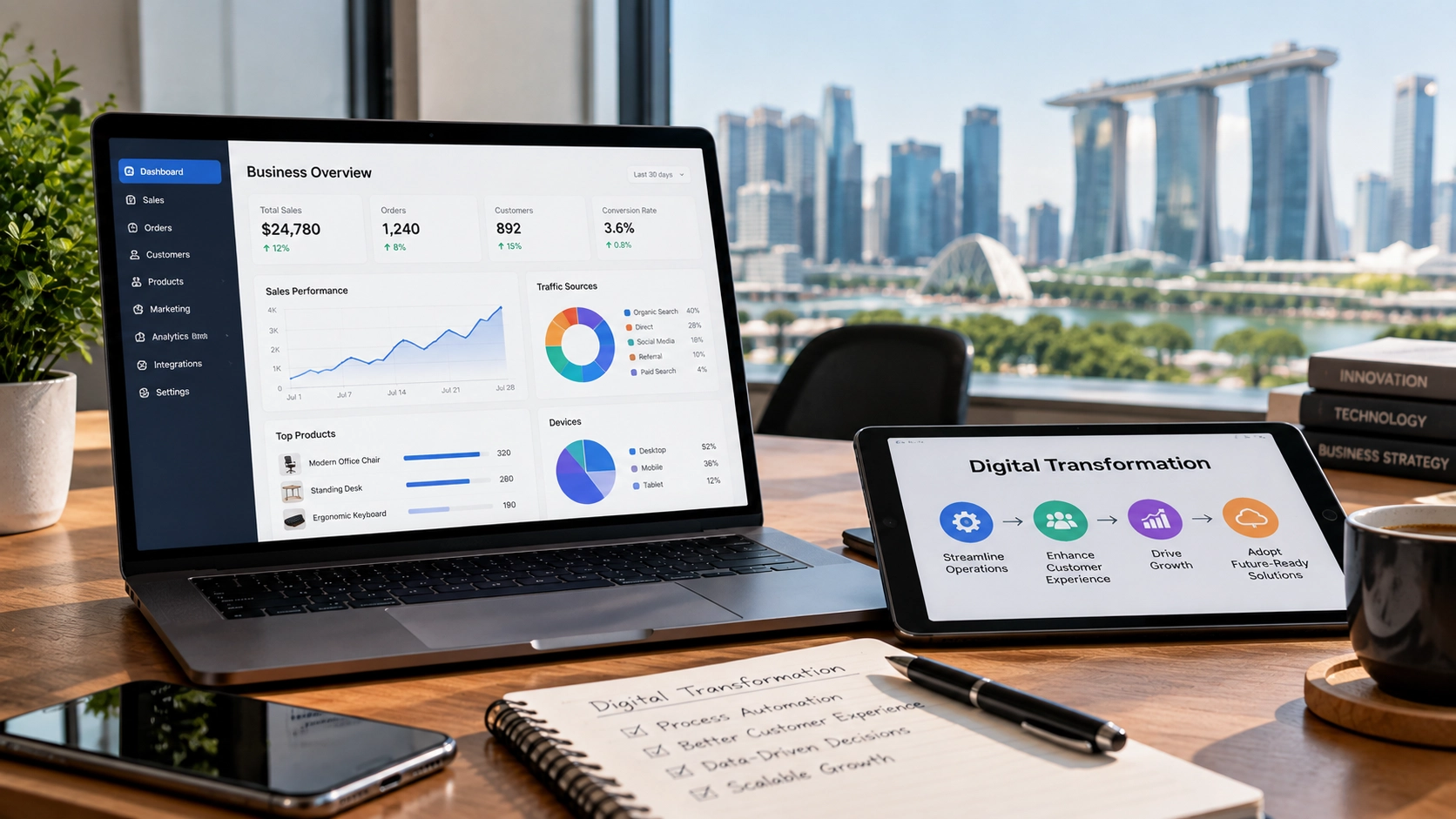
In Singapore business circles, “digital transformation” gets used so freely that it’s starting to mean everything and nothing at the same time. Every vendor selling software, every consultant with a framework and every government initiative seems to claim it as their territory. But strip away the jargon and the definition is actually quite simple: digital transformation in Singapore is the process of using technology to fundamentally change how your business operates and how it delivers value to customers. Not just digitising your paperwork. Changing the core of how things get done.
Most Singapore businesses are somewhere in the middle of this process whether they’ve framed it that way or not. The question worth asking is whether you’re doing it deliberately or just reacting to pressure from competitors and customers who’ve already moved further along.
Why Digital Transformation in Singapore Has Accelerated
Singapore’s government has been one of the most active in the world when it comes to pushing businesses toward digital adoption. IMDA’s SMEs Go Digital programme, the PSG grant, the Digital Enterprise Blueprint and initiatives through Enterprise Singapore have all been designed to reduce the financial and technical barriers to adoption. The result is that Singapore SMEs are digitising faster than their regional peers, which is raising the competitive floor for every sector.
Research from McKinsey Digital consistently shows that companies which invested in digital capabilities before they felt pressure to do so outperform those that waited. Singapore’s digital transformation story is no different. The businesses that started three years ago are now significantly harder to catch. The ones starting now are right on time. The ones waiting are starting to feel it in their pipeline.
What Digital Transformation in Singapore Actually Looks Like for an SME
For a large enterprise, digital transformation might mean rebuilding the entire supply chain, moving core systems to the cloud and retraining hundreds of people. For a Singapore SME, it’s usually more targeted and more practical.
It might start with a website that actually works: one that generates leads, answers customer questions and represents your business properly instead of sitting as a neglected placeholder from five years ago. From there, it might extend to a CMS that lets your team publish content and update your services without calling a developer. Then maybe an eCommerce layer that lets you sell to customers you’d never meet in person. Then a web application that automates the manual internal processes your team spends hours on every week.
None of that requires a complete organisational overhaul. But each step makes the business more capable, more efficient and harder to compete with. Our post on web application development in Singapore covers what the custom software layer of this journey looks like and our guide to CMS development in Singapore explains how putting content control in your team’s hands changes the pace of your marketing entirely.
Your Website Is the Front Door of Your Digital Transformation
It’s tempting to think of digital transformation as internal: better processes, better tools, more automation. But the most visible dimension of it is external. It’s how your customers experience you when they search for you, find your website, try to understand what you do and decide whether to reach out.
A slow, outdated or confusing website sends a signal about how the whole organisation operates. A fast, well-structured site that clearly communicates your value and makes it easy to get in touch signals exactly the opposite. For many Singapore businesses, this external digital face is the highest-leverage starting point for their transformation journey because it directly affects revenue right now, not just at some point in the future.
The AI-powered website service we offer is a good example of how the external digital face can be transformed in a targeted way: your existing site enhanced with an AI assistant that answers customer questions 24 hours a day, captures leads and reduces the load on your team without requiring a complete rebuild. Read more about that in our post on AI-powered websites in Singapore.
The Mistakes Singapore Businesses Make With Digital Transformation
The biggest one is treating it as a technology project rather than a business change. Buying software doesn’t transform anything. Changing how your team works, how your customers experience you and how decisions get made is what transformation actually is. Technology is the enabler, not the destination.
The second mistake is doing it all at once. Digital transformation in Singapore is most successful when it happens in deliberate, well-sequenced steps. Fix the website. Then automate the intake process. Then build the client portal. Each step builds on the last and generates the revenue or efficiency that funds the next one. Trying to do everything simultaneously usually means nothing gets done properly.
The third is picking tools before understanding the problem. Every vendor has a solution. Very few of them start by genuinely understanding how your business works. The best digital transformation projects start with a clear problem statement, not a product demo.
Where Silent Frontier Fits Into Your Digital Transformation Journey
We’re not a management consultancy and we don’t pretend to be. What we do is the technology side of the digital transformation work that Singapore businesses need most: websites, web applications, eCommerce platforms and the CMS systems that let your teams run them. We’ve done this for government agencies, multinational corporations and growing SMEs and we understand how the external digital presence and the internal operational tools need to connect.
You can see a selection of that work on our Our Work page and get a clearer picture of our approach at About Us.
If you want to have a straight conversation about digital transformation in Singapore for your business, talk to us. We’ll tell you where to start, what order to do things in and what it’ll actually cost.